-1.png?width=122&height=75&name=AG%20Logo%20ReImagined%20-%20Gold%20Text%20(Main)-1.png)



Many organisations see SAP S/4HANA migration as necessary but risky.
SAP migration is often associated with long timelines, operational risk, and potential business disruption.
This challenge is particularly significant in oil and gas, where 24/7 operations mean even minor disruptions can cause major operational and financial impacts.
Spirit Energy, a leading UK energy producer, faced a fixed deadline to modernise its SAP landscape as its third-party data centre neared the end of life. The company needed to act quickly while maintaining uninterrupted support for finance, procurement, maintenance, and operations.
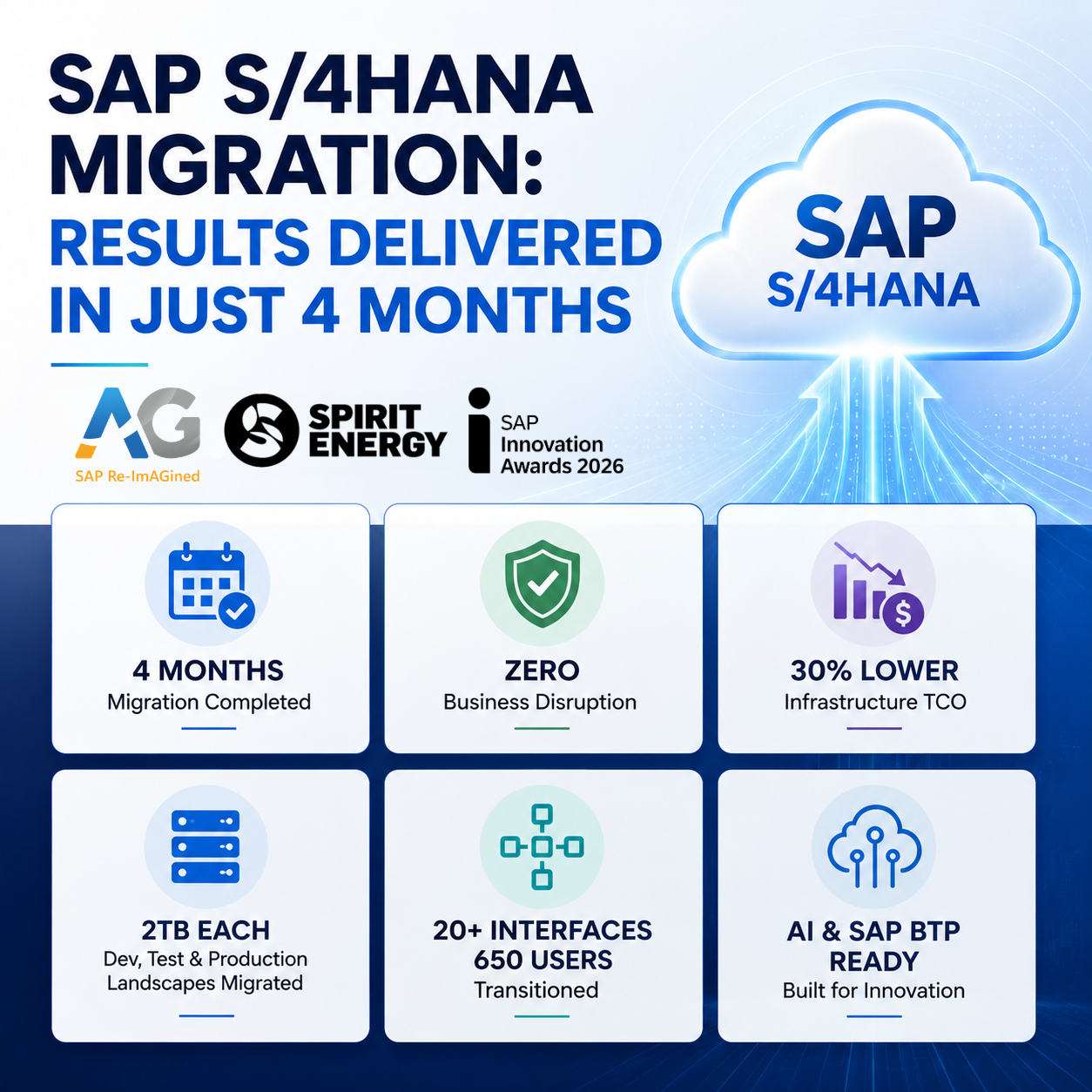
With AG, an SAP Gold Partner with experience in oil, gas, energy, and utilities, Spirit Energy migrated its SAP S/4HANA in just 4 months without business disruption.
This year, SAP recognised our project as a finalist in the 2026 SAP Innovation Awards.
In this article, let's explore how this was achieved and what other organisations can learn from this approach.
Business transformation, like a decision to move from natural gas production towards carbon capture and storage, needs to be driven by an intelligent enterprise with a robust digital infrastructure
Why SAP S/4HANA Migrations Are Often Challenging
Most SAP Cloud ERP transformation initiatives start with clear goals, such as modernising infrastructure, improving agility, and laying a foundation for future innovation.
However, achieving those goals is rarely straightforward.
Many organisations rely on SAP environments that have evolved over the years, accumulating customisations, integrations, and technical debt that increase complexity and risk.
Common challenges include:
- Extensive customisations and legacy processes.
- Rising infrastructure and maintenance costs.
- Complex integrations across multiple systems.
- Large volumes of business-critical data.
- Regulatory and compliance requirements.
- Limited tolerance for downtime.
- Pressure to deliver rapid business value.
The Challenge Faced by Spirit Energy
-
Spirit Energy needed to upgrade from the 2016 version of S/4HANA because support for it was ending.
-
The timescale was constrained by Spirit Energy’s financial year-end and planned plant maintenance activity.
-
The existing S/4HANA solution had a complex configuration and was integrated with several other applications for reporting, project management, and process automation.
The AG Approach: Speed Without Compromising Stability
From the outset, SAP proved to be the right partner to support our immediate needs and future ambitions. However, it was the expertise and dedication of AG Consultancy & Apps that ensured a rapid and seamless transition in just four months. This move to RISE with SAP, expertly guided by AG, provides the modern cloud landscape essential for achieving our long-term strategic objectives, particularly in our carbon capture transition.
A key factor in the project's success was AG's decision to adopt a pragmatic brownfield migration strategy focused on speed, stability, and risk reduction. Rather than redesigning business processes during the migration, AG prioritised establishing a secure, scalable cloud foundation while maintaining business continuity.
The approach included:
- Technical assessments to evaluate the SAP landscape, integrations, and dependencies
- SAP Readiness Check and clean core principles to identify simplification opportunities
- A homogeneous system copy approach to efficiently migrate large data volumes while preserving system integrity
- Rigorous testing, governance, and cutover planning delivered in collaboration with the SAP ECS team
How the Four-Month SAP S/4HANA Migration was Achievable by AG
Our team's expertise, combined with our commitment to delivering tangible business value, has enabled Spirit Energy to not only optimise their current operations and achieve substantial cost savings but also to build a robust digital foundation for future innovation in carbon capture and beyond.
Several factors contributed to the programme’s success.
Deep Industry Expertise
AG’s experience across SAP oil, gas, energy, and utilities enabled the team to understand operational constraints, maintenance schedules, regulatory considerations, and sector-specific business priorities.
This industry knowledge significantly reduced project risk.
A Single Strategic Delivery Partner
AG managed the transformation programme from planning to execution, working closely with SAP at every stage.
This reduced coordination complexity and improved decision-making speed.
Clean Core Principles
By avoiding unnecessary customisation and focusing on a clean core architecture, AG prevented technical debt from being carried over to the new environment.
This simplified the migration and positioned Spirit Energy for future innovation.
Governance Built Into the Programme
Governance, risk management, stakeholder alignment, and testing were integrated throughout the project lifecycle to ensure a smooth go-live.
Results Achieved in Just Four Months of SAP S/4HANA Migration
OGE Companies and AG's Delivery/Implementation Approach
The Spirit Energy project provides important lessons for organisations planning their own SAP S/4HANA migration.
First, speed and risk are not opposites. Well-executed projects move faster by avoiding unnecessary complexity.
Second, organisations do not need to redesign every process during migration. Establishing a stable cloud foundation first often leads to more effective long-term transformation.
Third, industry expertise is critical. Sector-specific knowledge reduces risk, improves planning, and accelerates delivery.
Finally, cloud migration should be seen as a business strategy, not just an infrastructure project. The greatest value comes from creating a platform that supports future innovation, automation, AI, and growth.
A Proven Framework for Faster SAP S/4HANA Migration
Successful SAP transformations require more than technical expertise; they demand deep industry knowledge, proven methodologies, and a clear focus on business outcomes.
AG combines extensive SAP expertise in the oil, gas, and energy sector with S/4Energy, our SAP Qualified Partner Packaged Solution (QPPS). Built specifically for energy companies, S4Energy leverages pre-configured industry processes, proven accelerators, and a clean-core approach to reduce migration risk, accelerate time-to-value, and streamline SAP S/4HANA adoption.
The Spirit Energy project demonstrates this approach in practice, delivering a successful SAP S/4HANA migration in just 4 months while maintaining business continuity and laying the foundation for future innovation.
Ready to accelerate your SAP S/4HANA migration?
Connect with AG's SAP transformation experts to assess your current landscape, reduce migration risk, and build a tailored roadmap to RISE with SAP and cloud ERP success.