-1.png?width=122&height=75&name=AG%20Logo%20ReImagined%20-%20Gold%20Text%20(Main)-1.png)



As organisations continue to digitise maintenance and supply chain operations, they are increasingly recognising that reducing downtime requires more than effective maintenance planning. Despite being heavily invested in predictive maintenance, condition monitoring, and asset management technologies to improve reliability, many maintenance activities are still delayed for reasons that have little to do with the maintenance process itself.
The challenge lies elsewhere. It requires seamless coordination between maintenance, warehousing, transportation, and field execution. In our previous blog, "How SAP Field Logistics Transforms End-to-End Supply Chains," we explored how SAP Field Logistics improves visibility and control across complex logistics networks.
To continue the discussion, this blog focuses on a critical operational challenge that every asset-intensive organisation is trying to address: reducing unplanned downtime. We'll explore:
-
Why logistics is becoming a major contributor to unplanned downtime
-
Common causes of maintenance-related delays
-
How SAP Field Logistics connects maintenance and logistics processes
-
How organisations in Oil & Gas, Energy, Mining, Utilities, and other asset-intensive industries can improve operational reliability
-
S4 Field Logistics for a connected warehouse-to-field logistics model
Let's dive in!
Why Logistics Has Become a Critical Factor in Asset Reliability
Many organisations operate with sophisticated maintenance systems but fragmented logistics processes.
Every year, the world's largest asset operators invest heavily in predictive analytics, IoT sensor networks, and AI-driven failure detection. Returns are real but partial. According to Siemens True Cost of Downtime, an industry analysis, unplanned downtime across Fortune Global 500 industrial companies still costs an estimated $1.5 trillion annually, representing 11% of revenues, up from 8% in 2019. The question serious executives should be asking is: why is the number going up even as the technology gets smarter?
Maintenance planning often sits within Enterprise Asset Management (EAM), while warehouse activities, transportation management, inventory visibility, and field operations are managed separately.
When a high-pressure valve fails on an offshore platform, the sensor detects it. The EAM system generates the work order. The planner checks the inventory, the part shows available. A technician is dispatched. He arrives to find the part was consumed two days ago on a neighbouring rig and never recorded in the system. The repair is delayed 72 hours. Emergency procurement costs 10x to 20× the standard price. The downtime cascades.
That is a logistics failure, not a maintenance failure. This creates operational blind spots that can significantly delay maintenance execution and directly affect the asset reliability. Here is where SAP Field Logistics exists to precisely close that gap.
What Is SAP Field Logistics?
SAP Field Logistics is designed to help organisations manage the movement, tracking, deployment, and return of materials, equipment, tools, and resources required to support field operations and maintenance activities.
Rather than treating logistics and maintenance as separate functions, SAP Field Logistics creates a connected process that links maintenance demand with logistics execution.
This enables organisations to coordinate warehouse operations, transportation activities, inventory management, field deployments, and maintenance schedules from a single operational perspective.
What common causes of downtime-related delays does SAP Field Logistics intend to eliminate?
-
Spare parts unavailable when maintenance begins
-
Materials located in the wrong warehouse
-
Lack of visibility into shipment status
-
Delays in equipment mobilisation
-
Inefficient staging and kitting processes
-
Poor coordination between warehouses and field teams
-
Limited visibility across remote or offshore operations
As asset-intensive industries continue to operate across geographically dispersed sites, reducing these downtime-related delays has become essential for improving logistics operational performance.
How SAP Field Logistics connects maintenance and logistics into a single execution thread
SAP Field Logistics is not a standalone mobile inventory application. It is the execution layer that fuses SAP's plant maintenance, warehouse management, and materials management processes into one connected, real-time workflow, from work order creation through to field confirmation and materials posting.
The integration architecture is deliberately deep. SAP Field Logistics connects natively with Maintenance Orders, Network Orders, Logistics Execution (LE), SAP Inventory Management (IM), and SAP Extended Warehouse Management (EWM) — eliminating the information silos that exist when these processes run in parallel rather than in sequence.
When they run together, the following flow becomes possible:
-
Work order created in S/4HANA PM — material requirements automatically generate reservations in Inventory Management or transfer orders in EWM. Warehouse team sees the job, its criticality, and its due date immediately.
- EWM picks and stages the kit — using next-generation kitting and staging embedded in SAP Field Logistics, warehouse teams assemble all components for the job into a single staged kit. No individual part-hunting by technicians.
- Field technician confirms receipt via mobile — SAP Field Logistics app running on iOS or Android. Barcode scan or RFID. The goods issue posts to S/4HANA immediately. Inventory is decremented in real time. Work order cost is updated.
- Job executed and confirmed in the field — time confirmations, completion status, and technical findings feed back into the maintenance order and asset history. All data posts directly to S/4HANA without any end-of-day reconciliation.
- Returns processed on the same device — unused parts, replaced components, and warranty-eligible materials are returned and recorded in the field. Reverse logistics triggers automatically. Recovered stock re-enters the system immediately.
- MRP and replenishment fire automatically as field consumption is posted in real time. Materials Management's reorder point logic triggers before stock falls to a critical level. Planned procurement replaces emergency sourcing.
This flow only exists when all six nodes are connected. When maintenance and logistics operate separately, as they still do in most asset-intensive organisations, every handoff between them is a potential source of delay. SAP Field Logistics eliminates those handoffs.
How can asset-intensive industries improve operational reliability with SAP Field Logistics?
The value of a connected warehouse-to-field logistics model is not uniform. It scales with asset criticality, geographic complexity, and the cost of each additional hour of downtime. Here is what the solution delivers across the major industries where it matters most.
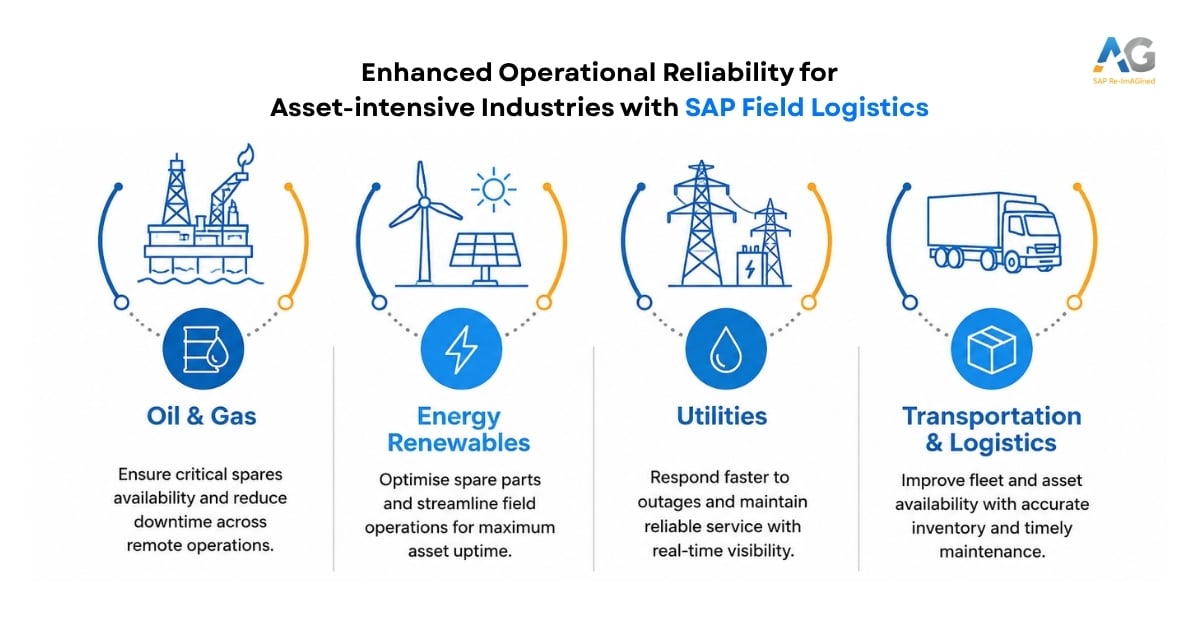
SAP Field Logistics for Oil & Gas
Core Challenge: Remote assets, dispersed field teams, and unplanned equipment failures can lead to costly downtime, safety risks, and production losses.
What connected logistics delivers: SAP Field Logistics improves material visibility, coordinates inventory across warehouses and field locations, and ensures critical spare parts are available when and where they are needed, helping maintain operational continuity and reliability.
SAP Field Logistics for Energy & Renewables
Core Challenge: Wind farms, solar sites, and energy generation assets are often geographically dispersed, making spare parts management and maintenance coordination complex.
What connected logistics delivers: SAP Field Logistics streamlines material tracking and logistics operations, ensuring technicians have access to the right equipment and parts to support efficient maintenance and maximise asset uptime.
SAP Field Logistics for Utilities
Core Challenges: Utility providers must maintain reliable service across extensive networks while managing ageing infrastructure, emergency repairs, and strict regulatory requirements.What connected logistics delivers: SAP Field Logistics provides end-to-end visibility of field inventory and materials, enabling faster response to maintenance activities, improved resource planning, and reduced service disruptions.
SAP Field Logistics for Transportation & Logistics
Core Challenge: Fleet operators and logistics providers depend on reliable vehicles, equipment, and infrastructure to meet delivery schedules and customer expectations.
What connected logistics delivers: SAP Field Logistics enhances inventory accuracy and material traceability, helping organisations reduce maintenance delays, improve fleet availability, and keep operations running efficiently. Explore SAP for Transportation and Logistics.
Accelerate your Supply Chain Success with S4 Field Logistics
Built on SAP Cloud ERP Private, AG’s SAP-qualified partner-packaged solution, S4 Field Logistics, comprising S4 Field Logistics Core and S4 Field Logistics Pro modules, is an end-to-end solution designed to digitise and optimise supply chains in the Oil & Gas, Energy, and Mining sectors.
The solution integrates SAP EWM and SAP Field Logistics to automate material movements from warehouse to field with real-time mobile tracking and analytics. S4 Field Logistics Core focuses on real-time visibility, faster decisions, and end-to-end traceability from warehouse racks to field assets. S4 Field Logistics Pro extends control to procurement, containerisation, supplier collaboration, and voyage tracking, delivering complete onshore-offshore transparency for complex, multi-country operations.
Reducing unplanned downtime is no longer solely about maintaining assets. It is about ensuring that maintenance teams have immediate access to the materials, equipment, inventory, and logistics support required to execute work efficiently. For asset-intensive organisations, the ability to synchronise maintenance operations with logistics execution is becoming a key competitive advantage.
SAP Field Logistics provides the visibility and operational control needed to bridge this gap, helping organisations improve asset availability, reduce operational delays, and drive greater value from their SAP investments.
As the demands on maintenance and operations continue to grow, organisations that connect logistics with maintenance will be best positioned to achieve long-term operational excellence.
Ready for more resilient, visible, and automated field logistics operations?
Get in touch with experts today.