-1.png?width=122&height=75&name=AG%20Logo%20ReImagined%20-%20Gold%20Text%20(Main)-1.png)



SAP Business Data Cloud (SAP BDC) is designed to help enterprises transform scattered SAP and non-SAP data into a single, trusted source for analytics, AI, and sharper business decisions. By unifying enterprise data with business context and advanced analytics, SAP BDC enables organisations to break down silos, modernise their data landscape, and make confident decisions without the pitfalls of unnecessary data duplication.
For large enterprises, especially those spread across regions or managing complex assets, the real value isn’t just in collecting more data. It’s about making that data trusted, connected, and ready to drive intelligent business processes across the organisation.
This guide will walk you through what SAP Business Data Cloud offers, the business benefits it can unlock, and the key questions leaders should ask when considering SAP BDC for their organisation.
What Is SAP Business Data Cloud?
SAP Business Data Cloud is SAP’s managed data and analytics offering designed to bring together SAP and non-SAP data while preserving the business meaning and context behind that data.
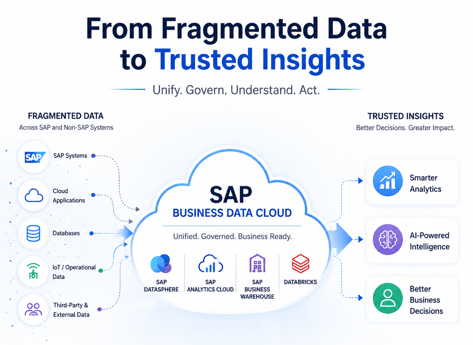
It brings together capabilities such as SAP Datasphere, SAP Analytics Cloud, SAP Business Warehouse, and Databricks, giving enterprises a robust foundation for data management, analytics, data science, and AI.
The aim is to help organisations move beyond fragmented data environments, where financial, sales, supply chain, asset, and operational information is scattered across disconnected systems.
With SAP BDC, you can create a connected data environment where business users and AI applications work from a single source of trusted, governed, and business-ready information.
Why Do Enterprises Struggle with Fragmented Data and How Does SAP BDC Fix It?
Enterprise data is rarely held in one place.
Sales information can be found in CRM platforms, financial data in your ERP systems, operational information in manufacturing or asset-management systems, and external data can be obtained from suppliers, partners, IoT platforms, or third-party applications.
This creates several business challenges:
-
Multiple versions of the same information.
-
Time-consuming data preparation.
-
Inconsistent business definitions.
-
Duplicate data across platforms.
-
Limited visibility across business functions.
-
Slow reporting and decision-making.
-
Difficulty scaling AI initiatives.
-
Increasing data governance and compliance complexity.
These challenges are even more pronounced in asset-heavy industries like energy, oil and gas, utilities, and manufacturing.
For example, maintenance records, asset master data, operational metrics, financial details, and risk assessments often sit in separate systems, making it difficult to get a complete picture.
SAP BDC brings these data domains together, while preserving the business context needed to turn raw information into actionable insight.
What Are the Key Business Benefits of SAP Business Data Cloud?
1. Create a Trusted Enterprise Data Foundation
One of the biggest advantages of SAP BDC is that it gives you a more reliable foundation for enterprise data, leading to greater consistency and confidence in your reporting and decision-making.
Instead of relying on scattered extracts, spreadsheets, and duplicated datasets, you can establish governed data products that deliver consistent business meaning across the organisation.
For instance, you can standardise key terms such as revenue, asset criticality, and maintenance cost so every team works from the same business understanding.
This is especially valuable for companies operating across multiple countries, with several business units and diverse regulatory requirements.
2. Connect SAP and Non-SAP Data
Most businesses don’t operate entirely within SAP.
They also rely on third-party applications, cloud platforms, operational systems, spreadsheets, data lakes, and industry-specific tools.
SAP BDC lets you connect these diverse data environments without forcing every data source into a single location. The result is a more complete, enterprise-wide view far beyond traditional departmental reporting.
3. Preserve Business Context Across Data
Data without a business context can be difficult to interpret.
SAP BDC focuses on maintaining the semantics and relationships of enterprise data so that information remains meaningful when used across analytics, applications, and AI scenarios.
For example, an enterprise may have multiple systems that contain information about the same asset.
Simply combining those records does not automatically create useful information.
The business needs to understand:
-
Which asset is being referenced?
-
How critical is it?
-
Which business location does it belong to?
-
What maintenance history does it have?
-
What financial impact does it have on business revenue?
-
What operational risks are associated with it?
Preserving this business context is particularly important in complex and regulated environments, such as the UK, Europe, and the Middle East, where consistent definitions and governance can be critical.
With SAP Business Data Cloud, business users can work with meaningful data, not just data that has been technically connected.
4. Enable Faster Analytics and Self-Service Insights
Traditional enterprise reporting can involve multiple stages.
A business user identifies a question, requests data from IT, waits for extraction and transformation to complete, and eventually receives a report.
This can slow down decision-making.
SAP BDC supports governed access to business data and analytics capabilities, helping organisations shorten the journey from business question to insight.
For example, finance, operations or supply chain teams can analyse relevant information without depending on IT for every reporting requirement.
The result is not simply more self-service. The objective is self-service within a governed enterprise data environment. Faster access to insights while maintaining appropriate data governance.
5. Build a Stronger Foundation for Enterprise AI
AI is only as useful as the data and business context behind it.
An AI application working with fragmented, inconsistent or poorly governed data can produce unreliable insights.
SAP BDC provides a foundation for bringing trusted enterprise data and business context into AI-driven scenarios, including SAP’s Business AI capabilities and Joule. Enterprises can move from simply experimenting with AI towards building AI on a governed enterprise data foundation.
This can help organisations explore use cases such as:
-
Natural-language interaction with business data
-
Intelligent analysis
-
Forecasting
-
Anomaly identification
-
Planning support
-
Business recommendations
-
AI-assisted decision-making
For an asset-intensive organisation, for example, combining asset, maintenance, operational and financial information can create a stronger foundation for identifying potential risks and understanding their business impact.
6. Reduce Data Duplication and Data Complexity
Duplicating enterprise data across multiple systems can lead to more than just storage costs. It can also introduce:
-
Data consistency issues
-
Additional integration requirements
-
Governance challenges
-
Maintenance overhead
-
Conflicting versions of information
SAP BDC supports architectural approaches that enable organisations to access and work with data across their landscape without automatically creating additional copies of every dataset. Less unnecessary data movement and a simpler, more manageable data landscape.
The appropriate architecture depends on the specific source systems, workloads and business requirements, but the overall objective is to reduce unnecessary data movement and duplication.
This can be particularly valuable when organisations are trying to establish a Single Source of Asset Master (SSAM) approach and need consistent asset information across operational and business processes.
7. Strengthen Data Governance and Security
Enterprise data needs to be useful without becoming uncontrolled.
SAP BDC supports governed data management, access controls and data lineage capabilities that help organisations understand how information is sourced, managed and consumed. Greater confidence that business data is being accessed and used appropriately.
This becomes increasingly important as more users, analytics applications and AI capabilities access enterprise information.
For organisations operating across the UK, Europe and the Middle East, governance may also need to account for different regulatory, privacy and reporting requirements.
A governed data foundation helps organisations balance accessibility with control.
How Can AG Help with SAP Business Data Cloud?
For enterprises evaluating SAP Business Data Cloud, the challenge is not simply implementing another SAP platform. The greater challenge is determining how BDC should fit into the existing SAP, data, analytics and AI landscape.
AG helps organisations connect SAP transformation with measurable business outcomes. Book your SAP BDC Free Assessment today.
As an SAP Gold Partner with more than 25 years of SAP experience and an SAP Innovation Award Winner, AG supports enterprises across SAP data, analytics, cloud ERP, and business transformation.
Our capabilities include:
-
SAP Business Data Cloud strategy and implementation
-
Joule and SAP Business AI enablement
-
Data governance and business data modelling
-
Asset-intensive industry solutions
For organisations in sectors such as energy, oil & gas, utilities and manufacturing, AG can also bring industry-specific understanding of asset performance, risk, maintenance and operational data.
AG helps enterprises build a trusted data foundation that supports today’s reporting requirements while preparing the business for AI-driven decision-making.
Final Thoughts
SAP Business Data Cloud represents an important evolution in enterprise data management.
Its value is not simply in bringing multiple SAP technologies together. The broader opportunity is to create a trusted, governed and business-aware data foundation that connects SAP and non-SAP information and supports analytics, AI and better decision-making.
If your organisation is considering SAP Business Data Cloud, the best starting point is to assess your current data landscape, identify the highest-value business use cases and define a phased roadmap for modernisation.
Ready to explore what SAP Business Data Cloud could mean for your business?
Book a free consultation with our SAP experts. We’ll assess your current data landscape, identify potential business opportunities and help you understand how SAP Business Data Cloud could support sustainable growth.
Talk to our SAP experts today↗️