-1.png?width=122&height=75&name=AG%20Logo%20ReImagined%20-%20Gold%20Text%20(Main)-1.png)



Every CIO and Chief Data Officer has lived this moment: the board asks a simple question: “Why did margins drop in Q3?” What could take minutes to answer will become days of data hunt across SAP and non-SAP systems, regional spreadsheets, and many different versions of the truth.
SAP Business Data Cloud (SAP BDC) handles this challenge directly.
In this blog, let's explore SAP Business Data Cloud, its role in the new SAP Autonomous Suite, its significance for SAP BW customers, and its implications for enterprise data strategy.
What Is SAP Autonomous Suite, and Where Does SAP BDC Fit In?
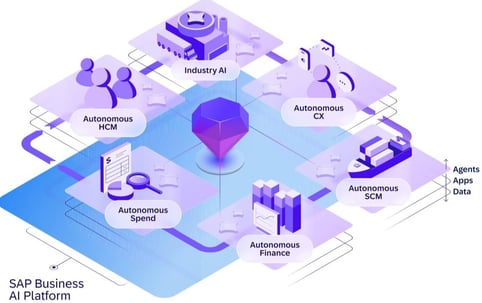
Understanding SAP Business Data Cloud requires knowing its role within SAP’s latest vision for an ERP suite for autonomous enterprises.
The SAP Autonomous Suite combines SAP S/4HANA Cloud, SAP Business AI, Joule, and intelligent business applications to help organisations automate processes, accelerate decision-making, and promote business outcomes with minimal manual operation. However, autonomous business operations can only be as effective as the data that powers them.
This is where SAP Business Data Cloud plays a key role. Serving as the trusted data foundation of the SAP Autonomous Suite, BDC unifies SAP and non-SAP data into a single, governed environment enriched with enterprise context. By providing high-quality, business-ready data, it enables AI agents, intelligent applications, and automation workflows to generate accurate insights, generate informed recommendations, and execute business processes with confidence.
Rather than being just another analytics platform, SAP Business Data Cloud is the data backbone that powers the Autonomous Suite, connecting data, analytics, and AI to create intelligent, self-optimising business operations.
What Is SAP Business Data Cloud?
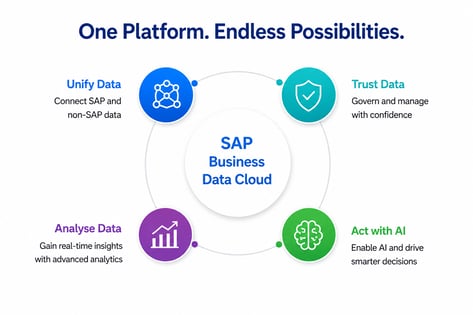
SAP Business Data Cloud (SAP BDC) is a fully managed SaaS data platform that unifies SAP and non-SAP data into a single, governed foundation designed for analytics, planning, and reliable AI.
It consolidates data integration, data lakehouses, semantic modelling, data products, a data marketplace, and knowledge graphs into a single architecture known as a business data fabric. According to SAP, this architecture connects data and context within a single, governed foundation, serving as the trusted knowledge core for all enterprise applications and AI agents.
The knowledge core distinguishes SAP BDC from generic data fabrics or data lakes by preserving business semantics and context. Terms such as “customer,” “cost centre,” or “delivery date” retain consistent definitions and logic throughout the system. This enables AI agents to accurately understand business operations and reduces the risk of conflicting or inaccurate AI outputs arising from segmented data.
The Core Components of SAP Business Data Cloud
SAP BDC is built from several integrated components:
SAP Datasphere
It works as the platform’s core data modelling and semantic layer, managing data integration, cataloguing, data products, and federation. It connects SAP sources, such as S/4HANA and SuccessFactors, with non-SAP sources, including Snowflake, Databricks, AWS, Google Cloud, and Microsoft Fabric.
SAC functions as the analytics, dashboarding, and planning engine, providing interactive dashboards, augmented analytics with natural-language queries, integrated financial and operational planning, and prebuilt Insight Apps that leverage BDC data products.
SAP Business Warehouse (BW)
SAP BW integration gives existing BW and BW/4HANA customers a clear modernisation runway. SAP BW workloads can be hosted as a Private Cloud Edition within BDC, with extended maintenance, gradual migration to Datasphere at your own pace, and the ability to reuse existing BW models inside the new data fabric.
SAP Databricks and SAP Snowflake
Both help extend BDC into the extended data science and AI ecosystem by enabling advanced ETL, model training, generative AI integration, and Delta Sharing for secure, zero-copy data exchange. This approach eliminates the need to duplicate large datasets across platforms.
SAP HANA Cloud
This provides the underlying lakehouse (a combined data warehouse and data lake) storage and compute layer, while the SAP Business AI Platform (the evolution of SAP BTP, or SAP Business Technology Platform) supplies technology services, governance tools, and developer tools that unify everything.
Why SAP Business Data Cloud Matters for Today’s Business
A Single Source of Truth Across SAP and Non-SAP Systems
Most large enterprises run SAP alongside dozens of non-SAP applications: CRM platforms, marketing tools, regional ERPs, homegrown databases, and cloud data warehouses. SAP BDC’s business data fabric connects all of this into one governed layer. Leadership no longer needs to reconcile five different versions of “revenue” before making a decision.
AI and Analytics Built on Trustworthy Data
Generative AI and agentic AI are only as good as the data feeding them. By preserving business semantics and context within the knowledge core, SAP BDC assures that AI agents, copilots such as Joule, and forecasting algorithms operate on consistent, accurate business logic. They no longer run on isolated, conflicting data signals.
Faster, Real-Time Decision-Making
With live data federation and zero-copy sharing across hyperscalers, decision-makers get access to current data quickly. They no longer need to wait on batch ETL jobs or refresh cycles. For CFOs, COOs, and LOB heads, this means insight delivery is measured in minutes, not days.
A Clear, Low-Risk Path for SAP BW Customers
For organisations still running SAP BW or BW/4HANA on-premises, SAP BDC delivers a structured modernisation path. Existing BW models, data flows, and business logic can be reused inside the new fabric. Extended maintenance windows give IT teams room to plan a phased migration rather than a disruptive cutover.
Lower Total Cost of Data Ownership
Decreasing data duplication, consolidating point-to-point integrations, and managing data through prebuilt data products all help reduce long-term infrastructure and maintenance costs. This is critical for CIOs justifying data modernisation budgets.
An Open, Multi-Cloud Ecosystem by Design
Instead of locking enterprises into a single analytics stack, SAP BDC is designed as an open data ecosystem. It has native, deepening partnerships across AWS, Microsoft, Google Cloud, Snowflake, and Databricks. This gives data architects the flexibility to use existing hyperscaler investments while gaining from SAP’s enterprise context layer.
What This Means for SAP BW Customers - The SAP BW Modernisation Journey
For many CDOs and data architecture leads, the most pressing question isn’t “what is SAP BDC”, it’s “what do we do about our existing SAP BW investment?”
This is where a planned approach matters. A proper SAP BW Modernisation Assessment should evaluate your current BW or BW/4HANA landscape, data volumes, custom transformations, and reporting dependencies before making any migration decision.
From there, organisations have several paths: continue BW/4HANA Modernisation in place with extended support; execute a phased SAP BW Migration into SAP Datasphere as a component of a broader SAP BW to SAP Business Data Cloud transition; or pursue a full SAP Business Warehouse Transformation that re-platforms reporting and planning workloads natively into BDC’s business data fabric.
Why Partner with AG for Your SAP Business Data Cloud Journey
Moving from “we know what SAP Business Data Cloud is” to “we have a governed, AI-ready data foundation live in production” is where most organisations need an experienced partner.
AG, as a SAP Gold Partner and the 2026 SAP Innovation Award UKI Winner, brings deep, hands-on expertise across the full modernisation lifecycle.
Our team has guided enterprises through SAP BW/4HANA Modernisation, SAP Business Warehouse Transformation, and SAP Datasphere Migration projects, focusing on minimising business disruption while maximising the long-term value of existing SAP investments, including landscapes already integrated with Snowflake and S/4HANA. We don’t just implement the technology; we help CIOs, CDOs, and data leaders build the business case, govern the rollout, and train teams to operate confidently in the new architecture.
If your leadership team is asking questions your data can’t yet answer, that’s the clearest signal it’s time for a conversation.
Ready to assess your SAP BW landscape or explore your path to SAP Business Data Cloud? Connect with AG’s SAP data experts to start with a tailored modernisation assessment.
Frequently Asked Questions