-1.png?width=122&height=75&name=AG%20Logo%20ReImagined%20-%20Gold%20Text%20(Main)-1.png)



SAP ECC to S/4HANA Migration Step-by-Step Guide
A practical, step-by-step roadmap to move from SAP ECC to SAP S/4HANA - covering strategy, data migration, costs, timelines, and business outcomes.
Speak to an SAP expert today

The Complete Free SAP ECC to S/4HANA Migration Step-by-step Guide 2026
The transition from SAP ECC to SAP S/4HANA is now a strategic necessity. With SAP ECC support deadlines approaching, organisations must modernise to remain competitive, agile, and data-driven. This SAP S/4HANA Migration Guide is designed for business and IT leaders who need a clear, actionable roadmap. It breaks down:
✅ Migration strategies (Greenfield, Brownfield, Hybrid)
✅ Data migration in SAP S/4HANA
✅ Cost, timelines, and risk consideration
✅ Business case development and ROI
✅ Real-world implementation insights
Whether you're in early planning or already evaluating migration options, this guide helps you:
↗️ Understand your personalised migration path
↗️ Avoid risky, costly mistakes
↗️ Align IT with business goals
↗️ Accelerate time-to-value
Get Your Free SAP S/4HANA Migration Guide
Why Move from SAP ECC to S/4HANA?
SAP ECC was built for a different era. S/4HANA is SAP's intelligent Cloud ERP built on in-memory computing, real-time analytics, and a modern cloud architecture that ECC simply cannot match.
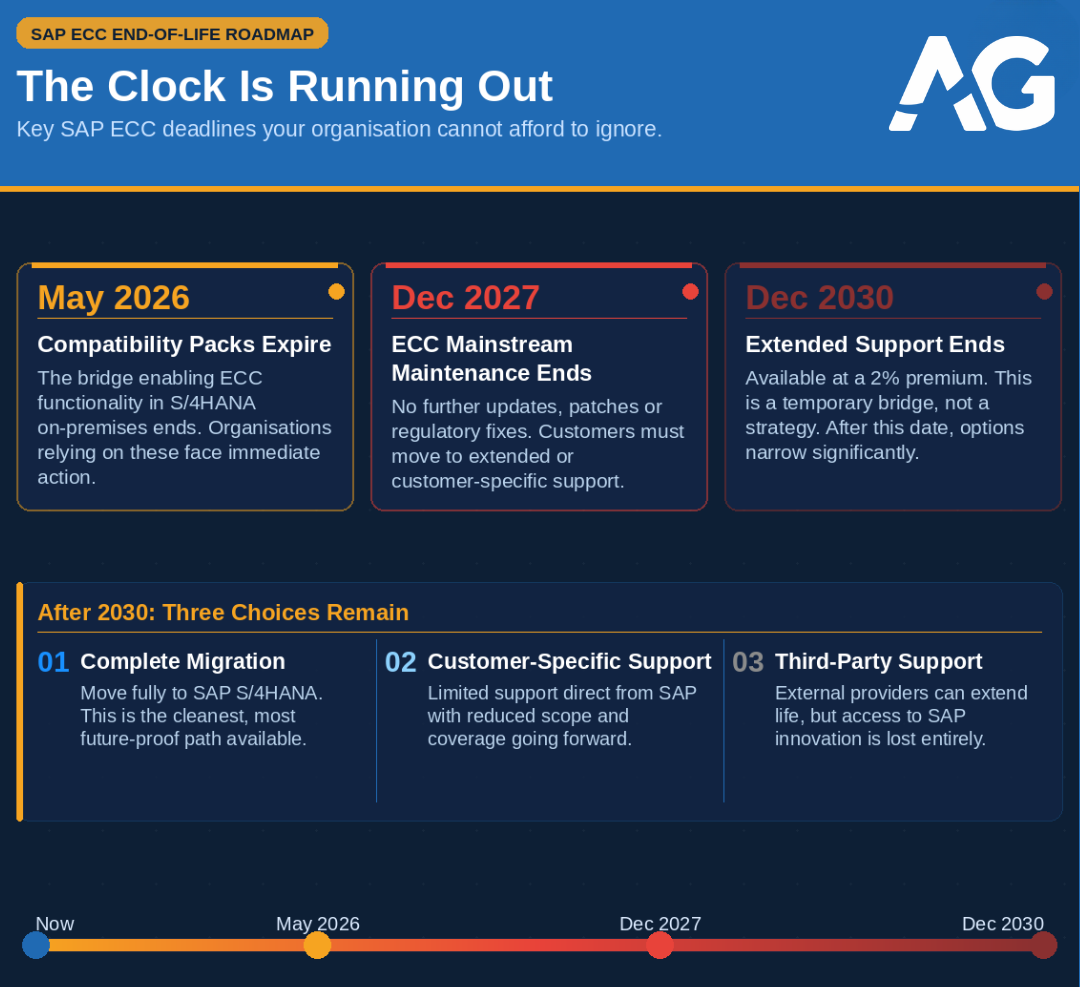
The longer you wait, the greater the risk of inefficiencies, higher support costs, and the struggle to find resources as the 2027 ECC deadline approaches.
The future is not about just keeping things running. It's about driving growth, resilience, and innovation with SAP S/4HANA.
SAP Gold Partner
Why Enterprises Choose AG for SAP S/4HANA Cloud Services
50%
Reduction in SAP Process Costs
Delivered for energy sector clients on S/4HANA Cloud.
100%
SAP Compliance Coverage
Achieved across every S/4HANA Cloud deployment.
20+
Years of SAP Cloud Expertise
Certified SAP Partner serving UK & Beyond
Trusted by leading UK & global enterprises for SAP S/4HANA Cloud Services - from energy and retail to healthcare and manufacturing.
Trusted by Industry Leaders Around the World










FAQ's
- Greenfield (New Implementation): Re-implement SAP S/4HANA from the ground up. This is ideal for businesses that want to redesign their entire business processes.
- Brownfield (System Conversion): Convert your existing ECC system to S/4HANA. This approach keeps your historical data and configurations.
- Selective Data Transition: This is a hybrid method that allows you to move specific business units, processes, or data at your own pace.
Here are three major common challenges faced in SAP ECC to S/4HANA Migration
1. Complex Legacy Landscapes
Most organisations need help transforming outdated, fragmented systems into a unified SAP S/4HANA platform.
2. High Degree of Customisation
Existing heavily customised Legacy ERP systems often require significant effort to align with S/4HANA's standardised workflows.
3. Unclean Master Data
Data inconsistencies and inaccuracies can complicate migration, necessitating a thorough data cleansing process.
- End of Support: SAP will end mainstream support for ECC in 2027, which raises risks. You can not access ongoing updates, regulatory compliance, and security patches.
- Efficiency & Innovation: With S/4HANA, your business can leverage improved automation, AI, and predictive analytics to drive smarter decisions and sustainable growth.
- Scalability: A future-proof platform is designed for cloud, hybrid, and intelligent enterprise models.

Speak to an SAP Expert today