-1.png?width=122&height=75&name=AG%20Logo%20ReImagined%20-%20Gold%20Text%20(Main)-1.png)



.png)
SAP S/4HANA migration challenges often include data, custom code, integrations, business processes, testing, security, and change management.
Success for enterprises migrating from SAP ECC to S/4HANA relies on selecting the right migration approach, minimising technical and business risks, and establishing a scalable foundation for cloud ERP, data, AI, and automation.
In this blog, let's discuss the biggest SAP S/4HANA Migration challenges and how successful businesses navigate them to maximise ROI on their SAP investments.
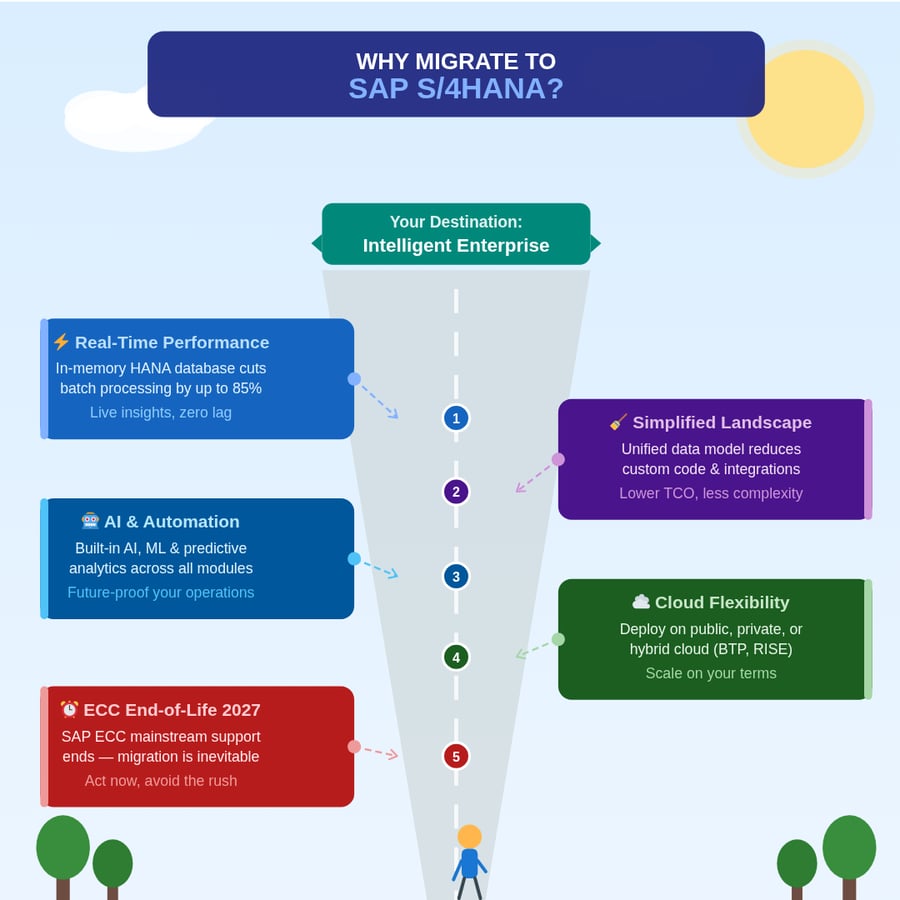
Why SAP S/4HANA Migration is important for Enterprises?
What Are the Biggest SAP S/4HANA Migration Challenges?
1. Data Migration and Data Quality
Poor-quality or duplicate data can cause issues well after go-live. Enterprises should determine which data to migrate, archive, cleanse, or transform.
Key considerations include:
- Master data quality
- Historical data
- Duplicate records
- Data ownership
- Data mapping and transformation
- Migration validation and reconciliation
- SAP and non-SAP data dependencies
2. Custom Code and Legacy Customisations
Existing SAP environments often include years of custom development. Each customisation should be evaluated to decide whether to retain, remediate, replace, rebuild, or retire it during migration.
Migration also offers an opportunity to reduce technical debt and support a clean-core approach.
3. Business Process Changes
S/4HANA migration can reveal inefficient processes, reliance on spreadsheets, manual approvals, and disconnected workflows.
Organisations should review current processes before migration to identify opportunities for standardisation, simplification, or redesign that add business value.
Tools such as SAP Signavio can help analyse existing processes and highlight areas for improvement.
4. Integration Complexity
S/4HANA rarely operates in isolation. Migration may affect integrations with:
- CRM
- WMS and logistics platforms
- Manufacturing systems
- Banking services
- Payroll
- Tax systems
- Field service applications
- Data and analytics platforms
- SaaS applications
All critical interfaces should be assessed, tested, and incorporated into the cutover plan.
5. Testing, Cutover and Business Continuity
Testing must extend beyond individual SAP modules. Enterprises should validate end-to-end business processes, integrations, migrated data, security, and user acceptance.
Cutover planning should address data freezes, final migration, interface shutdowns, reconciliation, user access, and rollback criteria.
What are the SAP S/4HANA Migration Approaches?
SAP identifies three primary transition approaches: System Conversion, New Implementation and Selected Data Transition.
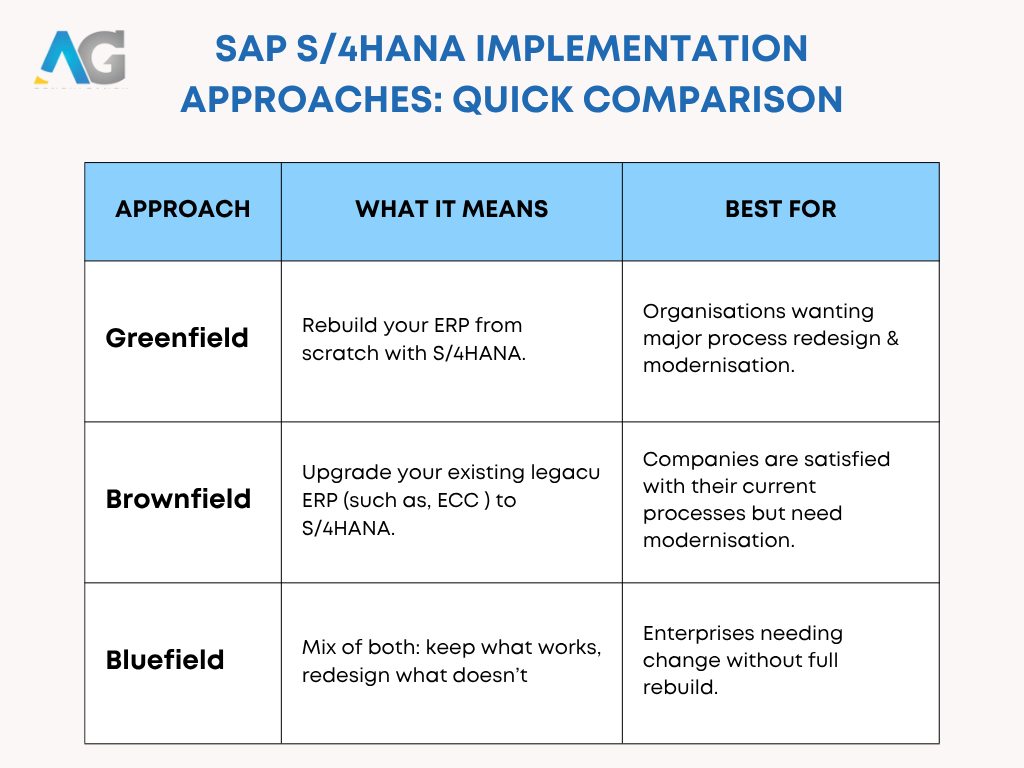
SAP S/4HANA Brownfield Migration: System Conversion
A Brownfield migration converts an existing SAP ERP system to S/4HANA while retaining much of the existing configuration, processes and data.
This approach suits organisations seeking to preserve existing investments while modernising their ERP landscape.
SAP S/4HANA Greenfield Implementation: New Implementation
A greenfield implementation begins with a new S/4HANA environment, offering greater opportunity to redesign processes, adopt standard SAP practices, and establish a clean core from the outset.
SAP S/4HANA Bluefield Implementation: Selective Data Transition
Selective Data Transition offers a middle path between system conversion and new implementation. Organisations can migrate relevant data and processes selectively while redesigning or harmonising parts of the landscape.
The SAP Greenfield, brownfield and Bluefield implementation approach relies on factors such as:
| Consideration | Key Question for Businesses |
| Business transformation | How much process change is required? |
| Data | What historical data needs to be retained? |
| Customisation | Which custom developments still provide value? |
| Landscape | How complex is the existing SAP environment? |
| Cloud strategy | What deployment model supports the future roadmap? |
| Time and risk | How much disruption can the business accommodate? |
How can Enterprises Manage SAP S/4HANA Migration Risks?
For organisations migrating from SAP ECC to SAP S/4HANA, risks often stem from complex legacy landscapes, extensive customisation, and poor-quality data.
To reduce these risks, enterprises should:
-
Audit the current SAP landscape to identify technical and integration dependencies.
-
Review customisations to determine which should be retained, adapted, or removed.
-
Cleanse and validate data before migration to prevent the transfer of inaccurate or duplicate data into S/4HANA.
-
Select the appropriate migration approach: Greenfield, Brownfield, or Selective Data Transition based on business requirements and the current SAP environment.
-
Plan testing and cutover carefully to minimise business disruption.
AG's structured SAP ECC-to-S/4HANA migration guide helps you to organisations identify risks early, set priorities, and develop a practical migration roadmap before implementation begins.
How Can You Start Your SAP S/4HANA Migration Journey?
A successful SAP S/4HANA migration begins with understanding your current SAP landscape before defining the target state.
AG’s SAP S/4HANA Migration Free Assessment helps enterprises evaluate their readiness, identify key migration considerations and understand the potential impact across their SAP environment.
The assessment can help you identify:
-
Current SAP landscape and migration dependencies
-
Data and customisation considerations
-
Integration and business process dependencies
-
Potential migration risks and challenges
-
Key priorities for your S/4HANA roadmap
As an SAP Gold Partner with over 25 years of experience, AG combines SAP expertise, industry knowledge and Solution Engineering to support organisations across the UK, Europe and the Middle East.
For asset-intensive organisations across Oil & Gas, Energy, Utilities, Chemicals, and Manufacturing, AG also brings expertise in its SAP QPPS solution, SAP EAM, field operations, logistics, and industry-specific SAP solutions.
Get your SAP S/4HANA Migration Assessment →
About AG
AG is an independent SAP Gold Partner and SAP consulting and digital transformation specialist supporting organisations across the UK, Europe and the Middle East.
With 25+ years of SAP experience and as an SAP Innovation Award UKI Winner, AG combines SAP expertise, industry knowledge, and Solution Engineering to support SAP S/4HANA Cloud transformation, migration, data, SAP Business AI Platform, automation, and asset-intensive operations.
AG is also an SAP Qualified Partner-Packaged Solutions (QPPS) provider, with industry-focused solutions for areas including Oil & Gas, Energy and field logistics.